Are Philosophers Absurd? Progress, Testimony & Dividing Labour
2025 | 2026
ISSUE NO. 2 | VOLUME CXXVI
MONDAY 19 January 2026
18.15 - 19.45
Woburn suite
about
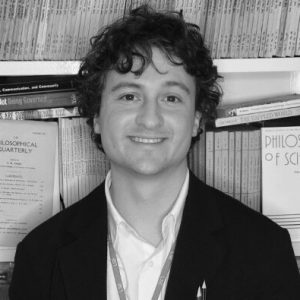
Lewis Ross is an Associate Professor in the Department of Philosophy, Logic and Scientific Method at the London School of Economics. He is also the Director of LSE’s Centre for Philosophy of Natural and Social Science (CPNSS). Lewis works on different topics at the intersection between epistemology, philosophy of law, and political philosophy. Right now, he is particularly interested in the theory and practice of criminal justice. His PhD was from the University of St Andrews and before that he completed a law degree.
ABSTract
Philosophy is much changed from the time that many of the analytic classics were produced. It now resembles, in many ways, a mature scientific discipline—with large division of cognitive labour. Big philosophical questions are routinely broken down into ever-smaller research questions and addressed in growing thousands of narrow publication units. Yet what purpose does this division of labour serve? Philosophers are notoriously sceptical about simply relying on each other’s published findings. Indeed, most publications seem to add to, rather than reduce, philosophical disagreement. There is a looming worry about absurdity here. Large amounts of intellectual effort are spent on activities that seemingly do not contribute to settling the core questions of the field. In response to this worry, some are tempted by radical claims about the point of philosophy. For instance, some say that it is an ‘exceptional’ field that does not aim to settle on knowledge or truth in the same way as other fields of inquiry. But this response, it seems to me, still leaves the structure of contemporary philosophy without justification. In this talk, I grapple with this problem and explore a more optimistic perspective. I consider a middle ground between two typical ways to think about philosophical progress: locating progress not in the mind of the individual, nor in the discipline as a whole, but rather in the small research communities that populate it.
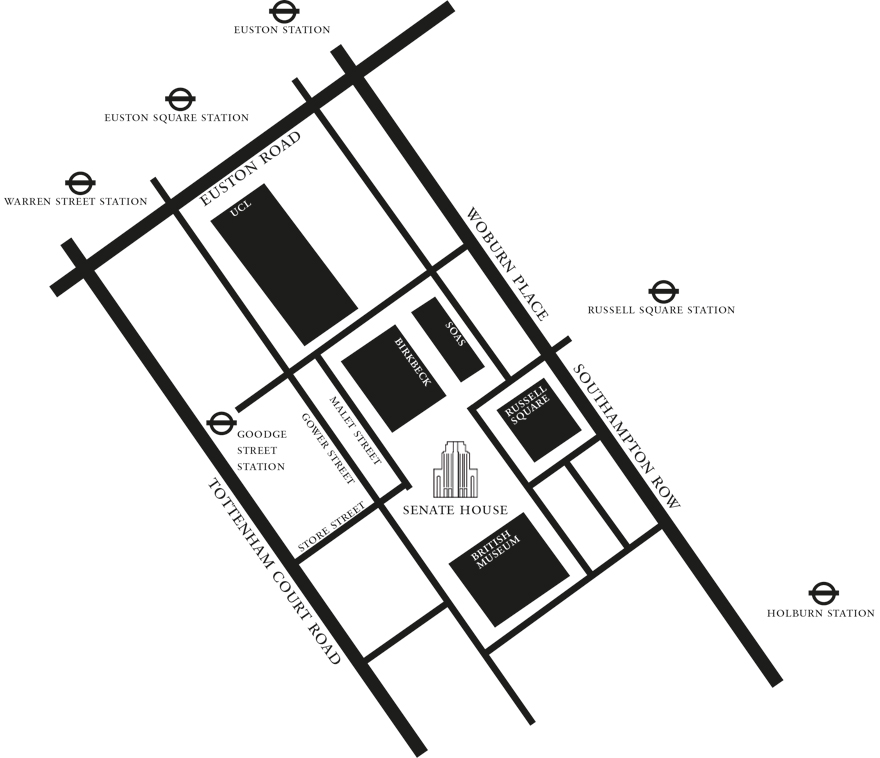
Our meetings usually take place in Senate House, University of London, Malet St, London WC1E 7HU. See top of page for specific location.
meeting time
The Society’s philosophy talks take place every fortnight on Mondays throughout the academic year. Each talk starts at 18.15 and lasts for 45 minutes. The remainder of the time is dedicated to discussion, which ends at 19.45
Catering
All of the Society’s philosophy talks are catered with fairtrade teas, coffees, and biscuits.
Admission
In line with the Society’s mission to make philosophy readily available to the general public, all talks are free and membership is not required.
Draft Papers
Following over a century of tradition, draft papers for all the talks are available in advance. Please note that draft papers can only be cited with the authors permission (see below for final publication and subscription details). The draft paper for a talk is available approximately one week prior to its schedule delivery.
Final Papers
For the past 142 years, the Proceedings has featured widely respected papers delivered by a range of prominent philosophers, such as Alfred North Whitehead, Ludwig Wittgenstein, Bertrand Russell, A.J. Ayer, P.F. Strawson, Karl Popper, Elizabeth Anscombe, Bernard Williams, Hubert Dreyfus, Alexander Nehamas, and Onora O’Neill. Final drafts of the papers – including discussion notes and exemplary graduate papers – are published in the Proceedings of the Aristotelian Society.
Accessibility
The venue at Senate House is wheelchair accessible and there are disabled toilet facilities on the ground floor. If you require a disabled parking space, or a hearing loop, please contact anna.stelle@aristoteliansociety.org.uk in advance, so that we can reserve these for you. Service animals are also welcome.